
Does the Centrifuge Matter? What Nobody Tells You About How PRF Is Made
PRF is not a standardised product. What ends up in the syringe depends on the machine that made it and the settings it was run at. Here is the version we would want to read.

PRF is not a standardised product. What ends up in the syringe depends on the machine that made it and the settings it was run at, and two practices can both accurately say they offer PRF while delivering materially different preparations. Almost nothing written for patients explains this. Here is the version we would want to read.
Rotor geometry
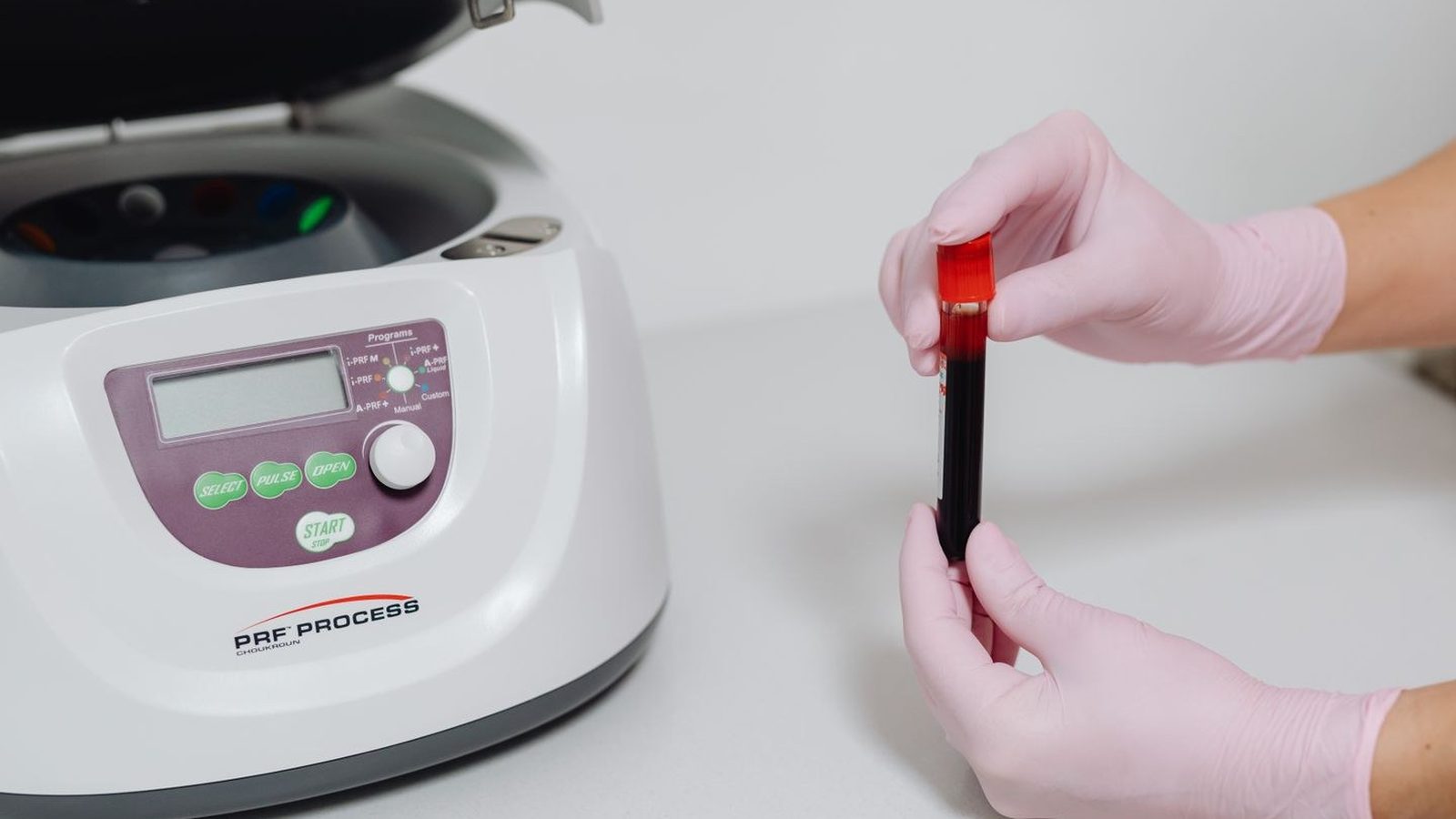
Centrifuges separate blood by spinning it. The shape of the rotor determines how that separation happens.
A fixed-angle rotor holds the tube at a slant, so cells are driven against the wall of the tube on the way down. A horizontal, or swing-out, rotor lets the tube swing level during the spin, so separation happens along the length of the tube.
Published laboratory work has compared the two directly. A 2019 study in the Journal of Biomedical Materials Research measured cell counts layer by layer and found higher platelet and leukocyte concentrations with horizontal centrifugation. A 2021 histology study in Platelets found horizontal spinning produced more evenly distributed platelets throughout the fibrin clot, where fixed-angle spinning accumulated cells along the tube wall. A 2020 evaluation of twenty-four different protocols reported yields up to about four times greater with horizontal machines, depending on the protocol and which fraction was measured.
The part the marketing pages leave out
You will see the four-times figure quoted as a flat fact. It is the ceiling of a range, not a typical result. In the head-to-head measurements of solid PRF, the difference was closer to one and a half to two times.
More importantly, nearly the entire body of evidence on horizontal centrifugation for PRF comes from one research group, and the lead author of that work discloses holding intellectual property in PRF production. The trade article most often cited for the four-fold headline was written by that same group. Independent replication is thin.
None of that makes the finding wrong. It does mean the honest way to describe it is as a laboratory measurement of cell concentration from a small number of related studies, rather than as an established fact about how your skin or hair will respond. No study has connected rotor geometry to an aesthetic outcome in a patient. Not one.
We would rather tell you that than let you assume more.
The technical detail that actually catches people out
PRF protocols are specified in g-force, written as relative centrifugal force. Most centrifuges are set in revolutions per minute. Those are not the same measurement, and converting between them requires knowing the radius of the rotor.
The consequence is that two practices can both run what they call the standard protocol at the same rpm, on machines with different rotor radii, and subject the blood to substantially different forces. Published analysis has pointed out that machines running the commonly quoted speed frequently exceed the g-force the protocol they are following actually specifies.
This is the single most checkable difference between a program run by someone who has read the literature and a program run by someone who bought a box and followed the card that came with it.
What we think patients should take from this
Not that you need to interrogate anyone about rotor design. Two questions cover it.
"What system do you use to prepare it, and why that one?"
"Is your protocol set in g-force or in rpm?"
You are not grading the answer on technical detail. You are finding out whether the person treating you has thought about it at all.
How we handle it
At Palm Beach Cosmetic Medicine, preparation is treated as a clinical variable rather than a background step. The system used for your treatment is named, the reason it was chosen is explained, and the parameters are set by protocol rather than improvised. Every regenerative protocol is designed and supervised by Dr. Anna Frisch, MD, PhD, a board-certified endocrinologist, who performs every PRP injection herself.
If you would like the specifics of what we use for your particular treatment, ask at your consultation and we will walk you through it.
Individual results vary. Neither PRP nor PRF is FDA-approved as a treatment; the devices used to prepare them are FDA-cleared as medical devices.
Frequently Asked Questions
- Does the centrifuge really matter for PRF?
- PRF is not a standardised product. What ends up in the syringe depends on the machine that made it and the settings it was run at, and two practices can both accurately say they offer PRF while delivering materially different preparations.
- What is the difference between a horizontal and a fixed-angle rotor?
- A fixed-angle rotor holds the tube at a slant, so cells are driven against the wall of the tube on the way down. A horizontal, or swing-out, rotor lets the tube swing level during the spin, so separation happens along the length of the tube.
- Is horizontal centrifugation proven to give better results?
- No study has connected rotor geometry to an aesthetic outcome in a patient. The honest way to describe the evidence is as a laboratory measurement of cell concentration from a small number of related studies, nearly all from one research group whose lead author discloses holding intellectual property in PRF production.
- Why does g-force versus rpm matter?
- PRF protocols are specified in g-force, written as relative centrifugal force, while most centrifuges are set in revolutions per minute. Converting between them requires knowing the radius of the rotor, so two practices running the same rpm on machines with different rotor radii subject the blood to substantially different forces.
- What should I ask about preparation?
- Two questions cover it: what system do you use to prepare it, and why that one; and is your protocol set in g-force or in rpm. You are finding out whether the person treating you has thought about it at all.
Dr. Anna Frisch, MD, PhD
Board-Certified Endocrinologist | Emory University School of Medicine-trained physician-scientist | Medical Director, Palm Beach Cosmetic Medicine | Founder, VitellaMD, Palm Beach Thyroid & Endocrinology Wellness, and Frisch Integrative Medicine
Dr. Anna Frisch, MD, PhD, is a board-certified endocrinologist, Emory University School of Medicine-trained physician-scientist, Medical Director of Palm Beach Cosmetic Medicine, and founder of VitellaMD, Palm Beach Thyroid & Endocrinology Wellness, and Frisch Integrative Medicine. She is one of the few board-certified endocrinologists in the US leading a cosmetic medicine practice. Her research is cited internationally, and she brings decades of experience in endocrinology, thyroid disorders, hormones, metabolic health, and patient-centered care. At Palm Beach Cosmetic Medicine, Dr. Frisch applies her medical background to aesthetic wellness by looking beyond the surface, connecting skin health, hair health, hormone balance, metabolic wellness, nutrition, collagen support, and advanced cosmetic treatments to help patients look refreshed, confident, and natural.
Not sure where to start?
Get your complimentary Skin IQ: a physician-led AI skin analysis with personalized recommendations in minutes.

Refined, physician-led cosmetic care in Wellington.
Schedule a private consultation to design a treatment plan around your skin, your goals, and the way you want to look and feel.