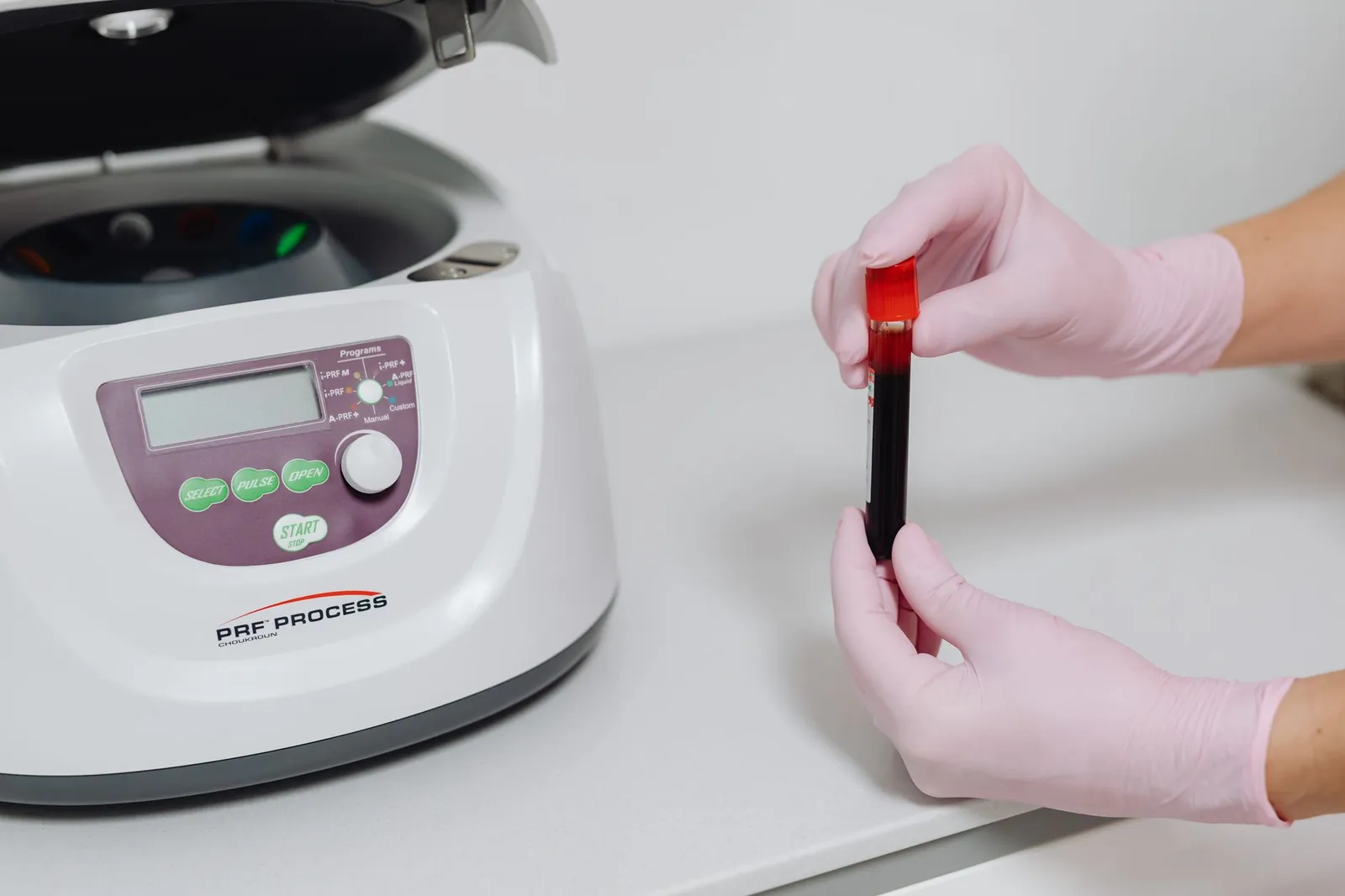
Platelet-rich plasma and platelet-rich fibrin both start the same way: a small draw of your own blood, spun in the office, used the same visit. What separates them is what happens in the tube.
PRP is drawn into a tube containing an anticoagulant, spun at higher force, and produces a liquid concentrate that delivers its growth factors quickly. PRF is drawn into an additive-free tube with no anticoagulant, spun at lower force, and clots naturally into a fibrin scaffold. In laboratory work measuring growth factor release over ten days, PRP released significantly more in the first fifteen to sixty minutes, and PRF released more in total across the full ten days. One is a faster signal. The other is a slower one held in place.
Neither is the upgrade. PRF is sometimes called second generation, which describes the preparation method rather than the results. Which one belongs in your treatment is a clinical decision about the area being treated and what you are trying to change, and it is made by Dr. Frisch as part of your protocol.