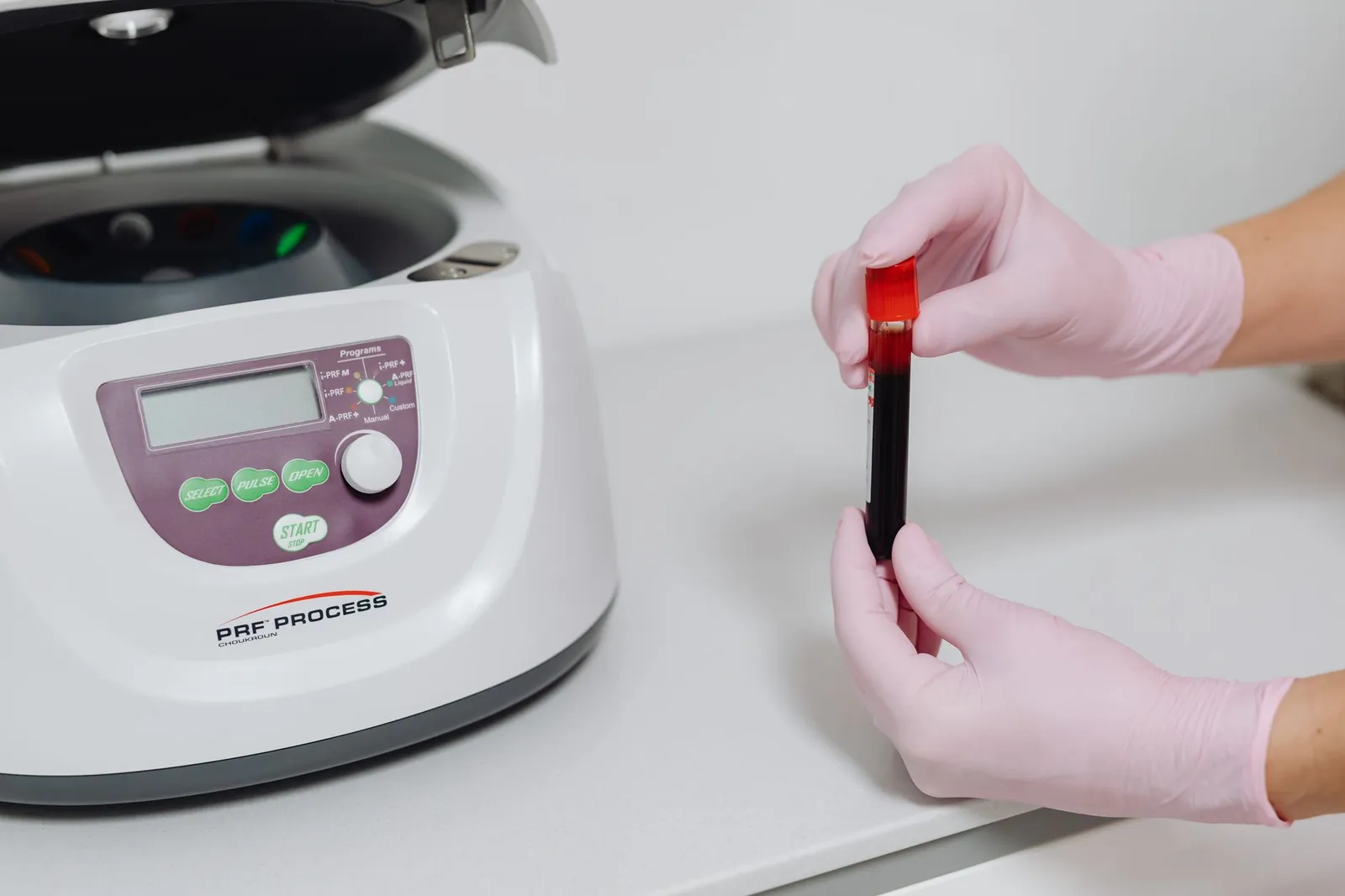
Hair restoration
For early to moderate androgenetic hair thinning in men and women. A series of treatments spaced four to six weeks apart, with maintenance afterward. Often combined with topical or nutraceutical protocols when appropriate.

Platelet-rich plasma prepared in-office using an FDA-cleared closed system, drawn and treated under physician supervision the same visit.
Medically reviewed by Anna Frisch, MD, PhD
Board-certified endocrinologist · Medical Director, Palm Beach Cosmetic Medicine
Last reviewed
PRP is short for platelet-rich plasma. We draw a small sample of your own blood, separate the platelet-rich fraction from the rest using a closed, FDA-cleared preparation system, and use it the same visit.
Platelets carry growth factors that signal your tissue to repair and remodel. There is no synthetic material, no donor tissue, and nothing added that did not come from you.
We launched PRP with the three applications where the clinical evidence is strongest and patient outcomes are most predictable.
For early to moderate androgenetic hair thinning in men and women. A series of treatments spaced four to six weeks apart, with maintenance afterward. Often combined with topical or nutraceutical protocols when appropriate.
PRP applied during and immediately after medical microneedling. Used for skin texture, tone, fine lines, post-acne scarring, and overall facial rejuvenation. Typically a series of three sessions.
Targeted PRP for the periorbital area to address thin skin, dark hollows, and crepiness in patients who are not ready for or not candidates for filler. Results build gradually over weeks.
Not all PRP is the same. Independent studies have shown wide variation in platelet concentration between commercial systems, and some commonly used kits actually deliver fewer platelets than whole blood.
We use the EmCyte PurePRP system, a dual-spin FDA-cleared device that produces a high-concentration platelet preparation with documented yield. The draw, preparation, and treatment all happen in one visit, in one room.
We confirm you are a candidate, review goals, and outline a treatment plan.
A standard venous draw, the same as routine bloodwork.
Your sample is processed in the closed system while you are prepped for treatment. About fifteen minutes.
PRP is delivered by injection, microneedling, or topical application depending on the indication.
Most patients return to normal activity the same or next day. Specific aftercare is reviewed in clinic.
Hair loss is rarely just a hair problem. Thyroid function, androgens, insulin resistance, and nutritional status all drive thinning, and a standard med spa is not equipped to consider any of them. Dr. Frisch built the Root Cause Hair Restoration Protocol℠ the way an endocrinologist builds any treatment plan: evaluation first, then a customized PRP formulation on the EmCyte PurePRP system, then a structured series with a maintenance plan. It is the difference between buying injections and following medicine.
Dr. Anna Frisch is a board-certified endocrinologist with an MD, a PhD, more than 26 years in practice and more than 40 scientific publications. Endocrinology studies how hormones govern hair, skin, weight and energy, which is why the questions asked here differ from those asked where the scalp is treated as a surface.
She designs and supervises every regenerative protocol at Palm Beach Cosmetic Medicine. The evaluation, the preparation, the formulation, the cadence and the maintenance schedule are hers, and treatment is delivered by our credentialed care team working to that protocol.
The Regenerative Glow Protocol℠, our physician-designed pairing of PRP with microneedling, applies the same logic to the skin. Collagen decline isn't just about time or sun, hormones, stress, and metabolic health all affect how your skin repairs itself, which is why the formulation, depth, and spacing of your series are set by protocol and reviewed as your skin responds, not applied off a standard template.
Designed to the Frisch Standard: evaluate the cause, choose the preparation, set the schedule, measure the response.
Our PRP is prepared on the EmCyte PurePRP SupraPhysiologic system, an advanced FDA-cleared concentrating system used at the point of care. The specifications below describe that PRP preparation specifically.

Supraphysiologic platelet concentrations, so there are more growth factors per treatment.
Over 99% of red blood cells removed for a cleaner, more comfortable result.
Formulation adjusted per patient and per treatment area, including neutrophil-poor preparations for delicate facial work.
Fully closed-system processing at the point of care.
Every PRP protocol at Palm Beach Cosmetic Medicine is designed and supervised by Dr. Anna Frisch, MD, PhD, a board-certified endocrinologist. Day-to-day treatment, the draw, preparation, and application, is delivered by our credentialed care team, including Elizabeth Melendez, our medical aesthetician, trusted by Dr. Frisch to provide PRP, laser treatments, and personalized skincare with a patient-centered approach. You'll know exactly who is treating you and who designed your plan.

Board-certified endocrinologist. Designs and supervises every PRP protocol.

Medical aesthetician. Delivers PRP, laser treatments, and personalized skincare.
PRP is generally well-tolerated because the material is autologous. Candidacy is reviewed at consultation and depends on the indication, your medical history, and current medications.
PRP is not appropriate for patients with active infection at the treatment site, certain blood disorders, active malignancy, or who are pregnant or nursing.
Platelet-rich plasma and platelet-rich fibrin both start the same way: a small draw of your own blood, spun in the office, used the same visit. What separates them is what happens in the tube.
PRP is drawn into a tube containing an anticoagulant, spun at higher force, and produces a liquid concentrate that delivers its growth factors quickly. PRF is drawn into an additive-free tube with no anticoagulant, spun at lower force, and clots naturally into a fibrin scaffold. In laboratory work measuring growth factor release over ten days, PRP released significantly more in the first fifteen to sixty minutes, and PRF released more in total across the full ten days. One is a faster signal. The other is a slower one held in place.
Neither is the upgrade. PRF is sometimes called second generation, which describes the preparation method rather than the results. Which one belongs in your treatment is a clinical decision about the area being treated and what you are trying to change, and it is made by Dr. Frisch as part of your protocol.
| PRP and PRF at Palm Beach Cosmetic Medicine | PRP | PRF |
|---|---|---|
| In the tube | Anticoagulant added | Nothing added |
| Spin | Higher force, often two spins | Lower force, single spin |
| What forms | Liquid concentrate | Fibrin scaffold that holds the platelets in place |
| Growth factor release | More in the first hour | More in total across ten days |
| White blood cells | Adjustable by protocol, including neutrophil-poor for delicate facial work | Inherently leukocyte-rich |
| Typically chosen for | Scalp series, hyperpigmentation, protocols needing a customised formulation | Under-eye and delicate facial areas, texture and crepiness, bio-filler |
| Regulatory status | Neither is FDA-approved as a treatment. The devices used to prepare them are FDA-cleared. Aesthetic use is off-label, which is lawful and standard. | |
Growth factor release comparison from Kobayashi et al., Clinical Oral Investigations, 2016. Leukocyte composition per the original leukocyte- and platelet-rich fibrin nomenclature. Whether higher leukocyte content improves aesthetic outcomes is unresolved in the literature and we do not claim that it does.
The fibrin scaffold holds the preparation where it is placed, which is the reason PRF is often selected over PRP for thin, delicate skin. Published studies of platelet preparations in the periorbital area report improvements in texture, crepiness and fine lines. The same literature finds that improvement frequently diminishes by around six months, so we plan a series and reassess rather than promising a duration.
Used for texture, tone and post-acne scarring. The published work on this specific combination is limited to a small number of studies, and we describe it as an option supported by early evidence rather than as an established standard.
A 2026 multicentre randomised trial in women with pattern hair loss compared PRP, injectable PRF and concentrated growth factors across four sessions, and reported greater hair-count improvement in the PRF and concentrated growth factor arms, with the lowest adverse-event rate in the PRF arm. That is one trial in one population, and PRP remains the more extensively studied option. Both are available and your protocol names which one and why.
Bio-filler is made by warming the plasma layer from your own draw so the albumin in it sets into a gel, then recombining that gel with liquid PRF. It adds volume using only your own blood, and patients searching for it online usually find it under the trade name EZ Gel. Coming to the practice this fall.
Patients who notice changes in visible texture, roughness, or overall skin quality after significant weight loss may wish to discuss whether microneedling or PRP aesthetic services fit into a broader aesthetic rejuvenation plan at PBCM.
Consultations are with our medical team. Bring any questions about candidacy, indications, or how PRP fits into a longer-term plan.
Noticing hair thinning or skin changes tied to hormones? Take the 2-minute Skin Quiz.
Take the quiz →Not sure where to start?
Get your complimentary Skin IQ: a physician-led AI skin analysis with personalized recommendations in minutes.