PRP or PRF for Hair Loss? What a 2026 Trial Actually Found
A 2026 multicentre randomised trial compared PRP, injectable PRF and concentrated growth factors in female pattern hair loss. Here is a careful read of what it found and what it does not settle.
Most pages comparing PRP and PRF for hair loss are written from opinion. A trial published this year gives us something better to work from.
The trial
A multicentre randomised clinical trial published in 2026 in the Journal of Dermatological Treatment compared three preparations in 74 patients with female pattern hair loss, across four treatment sessions: platelet-rich plasma, injectable platelet-rich fibrin, and concentrated growth factors.
The reported increases in total-area hair count were: concentrated growth factors, 27.1 percent; injectable PRF, 26.5 percent; PRP, 14.5 percent.
Hair diameter improved across all three arms with no significant difference between them. The injectable PRF arm had the lowest rate of adverse events.
What that does and does not mean
It is one trial. It enrolled women only, roughly twenty-five patients per arm, and the published results do not tell us how long the difference held after treatment ended.
PRP remains the more extensively studied option for pattern hair loss, with multiple systematic reviews and meta-analyses of randomised trials behind it. A single trial, however well conducted, does not overturn that body of work.
The accurate reading is this: early comparative evidence suggests PRF performs at least as well as PRP for pattern hair loss, and this trial found greater hair-count improvement in women. Larger and longer studies are needed before anyone should say more than that.
You will notice that is a narrower claim than you will read almost anywhere else. That is deliberate.
The variable nobody is comparing
Here is what a study design like this cannot capture, and what we think matters more than the choice between two preparations.
Hair loss is a symptom rather than a diagnosis. Thyroid dysfunction, androgen patterns, iron and ferritin status, vitamin D, insulin resistance, postpartum shifts, rapid weight loss, GLP-1 medications and several common prescriptions all suppress hair growth, frequently more than one at a time.
A trial enrols patients with a defined diagnosis and treats them identically. A clinic does not have that luxury and should not want it. If a patient has an untreated thyroid problem or a ferritin level on the floor, the question of PRP against PRF is close to irrelevant, because either one is working against a headwind that no injection technique overcomes.
This is why the evaluation comes first here. Dr. Anna Frisch is a board-certified endocrinologist with an MD and a PhD, more than 26 years in clinical practice, and internationally cited research, and the protocol she designed starts with the medical question rather than with the syringe.
How we choose between them
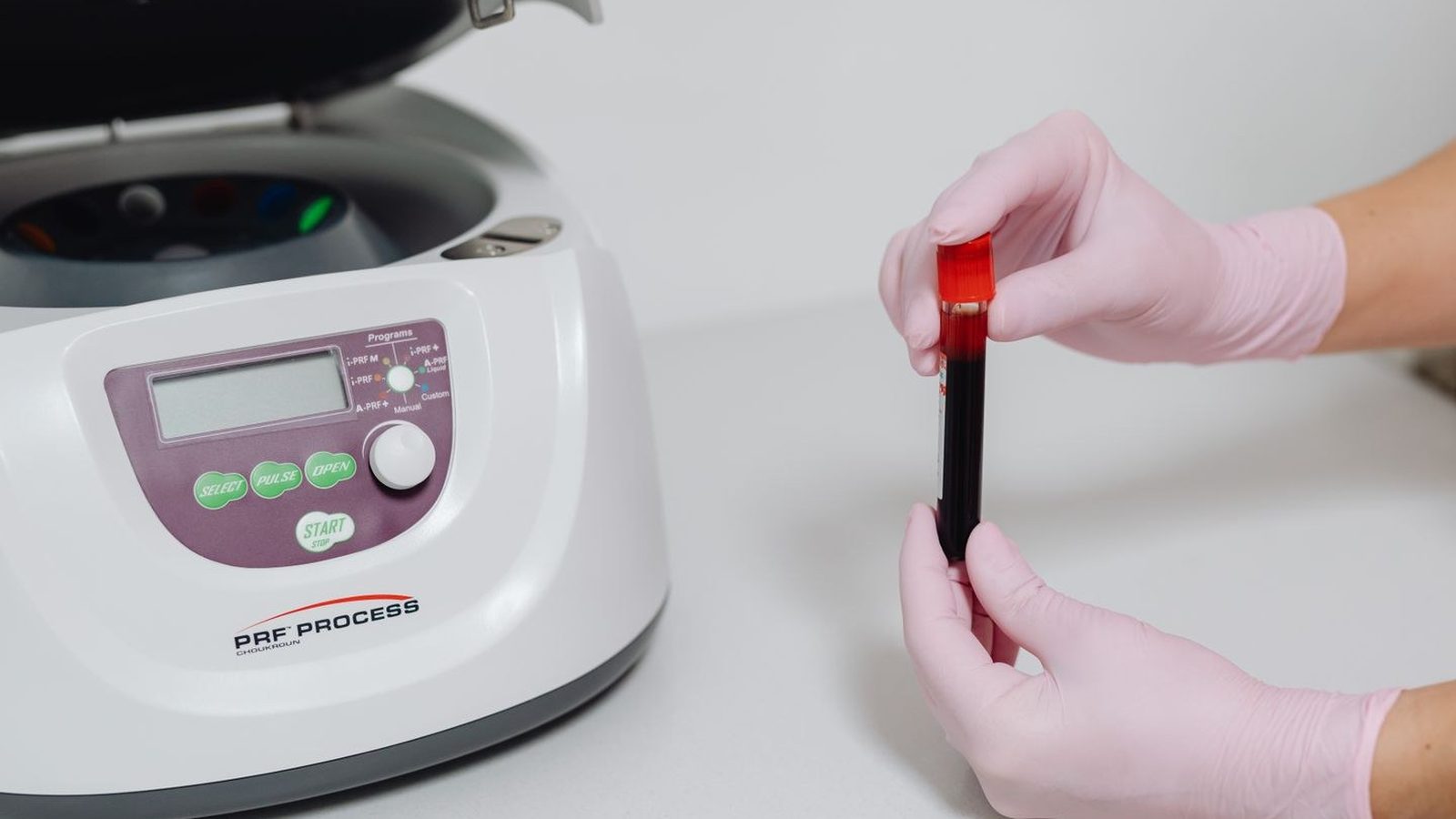
Both preparations are made from a small draw of your own blood in our Wellington office and used the same visit. PRP is drawn into a tube containing an anticoagulant and spun at higher force, producing a liquid concentrate that releases its growth factors quickly. PRF is drawn into an additive-free tube, spun at lower force, and clots into a fibrin scaffold that releases growth factors more gradually.
For the scalp we consider the pattern and stage of loss, whether a customised formulation is called for, how the area has responded to previous treatment, and what the evaluation turned up. Your protocol names which preparation is being used and why, so you are not left guessing.
Before you book anywhere
Ask what will be evaluated before anything is injected. Ask who designs the protocol and who delivers the treatment. Ask what happens if you are not responding at three months.
A practice that has good answers to those three questions will serve you better than one that has a strong opinion about PRP against PRF.
Physician-designed, at Palm Beach Cosmetic Medicine
Every regenerative protocol at Palm Beach Cosmetic Medicine is designed and supervised by Dr. Anna Frisch, MD, PhD, who performs every PRP injection herself. Consultations are complimentary.
Neither PRP nor PRF is FDA-approved as a treatment for hair loss. The devices used to prepare them are FDA-cleared as medical devices, which is a different thing. Individual results vary, and PRP is not appropriate for every type of hair loss.
Frequently Asked Questions
- What did the 2026 trial compare?
- A multicentre randomised clinical trial published in 2026 in the Journal of Dermatological Treatment compared platelet-rich plasma, injectable platelet-rich fibrin, and concentrated growth factors in 74 patients with female pattern hair loss, across four treatment sessions.
- What were the hair-count results?
- Reported increases in total-area hair count were 27.1 percent for concentrated growth factors, 26.5 percent for injectable PRF, and 14.5 percent for PRP. Hair diameter improved across all three arms with no significant difference between them, and the injectable PRF arm had the lowest rate of adverse events.
- Does this mean PRF is better than PRP?
- No. It is one trial, it enrolled women only, roughly twenty-five patients per arm, and the published results do not tell us how long the difference held after treatment ended. PRP remains the more extensively studied option for pattern hair loss. Larger and longer studies are needed.
- How do you decide between PRP and PRF for the scalp?
- We consider the pattern and stage of loss, whether a customised formulation is called for, how the area has responded to previous treatment, and what the evaluation turned up. Your protocol names which preparation is being used and why.
- Why does the medical evaluation come first?
- Hair loss is a symptom rather than a diagnosis. Thyroid dysfunction, androgen patterns, iron and ferritin status, vitamin D, insulin resistance, postpartum shifts, rapid weight loss, GLP-1 medications and several common prescriptions all suppress hair growth, frequently more than one at a time.
Dr. Anna Frisch, MD, PhD
Board-Certified Endocrinologist | Emory University School of Medicine-trained physician-scientist | Medical Director, Palm Beach Cosmetic Medicine | Founder, VitellaMD, Palm Beach Thyroid & Endocrinology Wellness, and Frisch Integrative Medicine
Dr. Anna Frisch, MD, PhD, is a board-certified endocrinologist, Emory University School of Medicine-trained physician-scientist, Medical Director of Palm Beach Cosmetic Medicine, and founder of VitellaMD, Palm Beach Thyroid & Endocrinology Wellness, and Frisch Integrative Medicine. She is one of the few board-certified endocrinologists in the US leading a cosmetic medicine practice. Her research is cited internationally, and she brings decades of experience in endocrinology, thyroid disorders, hormones, metabolic health, and patient-centered care. At Palm Beach Cosmetic Medicine, Dr. Frisch applies her medical background to aesthetic wellness by looking beyond the surface, connecting skin health, hair health, hormone balance, metabolic wellness, nutrition, collagen support, and advanced cosmetic treatments to help patients look refreshed, confident, and natural.
Not sure where to start?
Get your complimentary Skin IQ: a physician-led AI skin analysis with personalized recommendations in minutes.


Refined, physician-led cosmetic care in Wellington.
Schedule a private consultation to design a treatment plan around your skin, your goals, and the way you want to look and feel.