PRF Bio-Filler and EZ Gel: What It Is, and What It Is Not
Patients started asking us about EZ Gel before we had anything to say about it. It is worth explaining properly, including the parts the marketing pages skip.
Patients started asking us about EZ Gel before we had anything to say about it. It is worth explaining properly, including the parts the marketing pages skip.
What it actually is
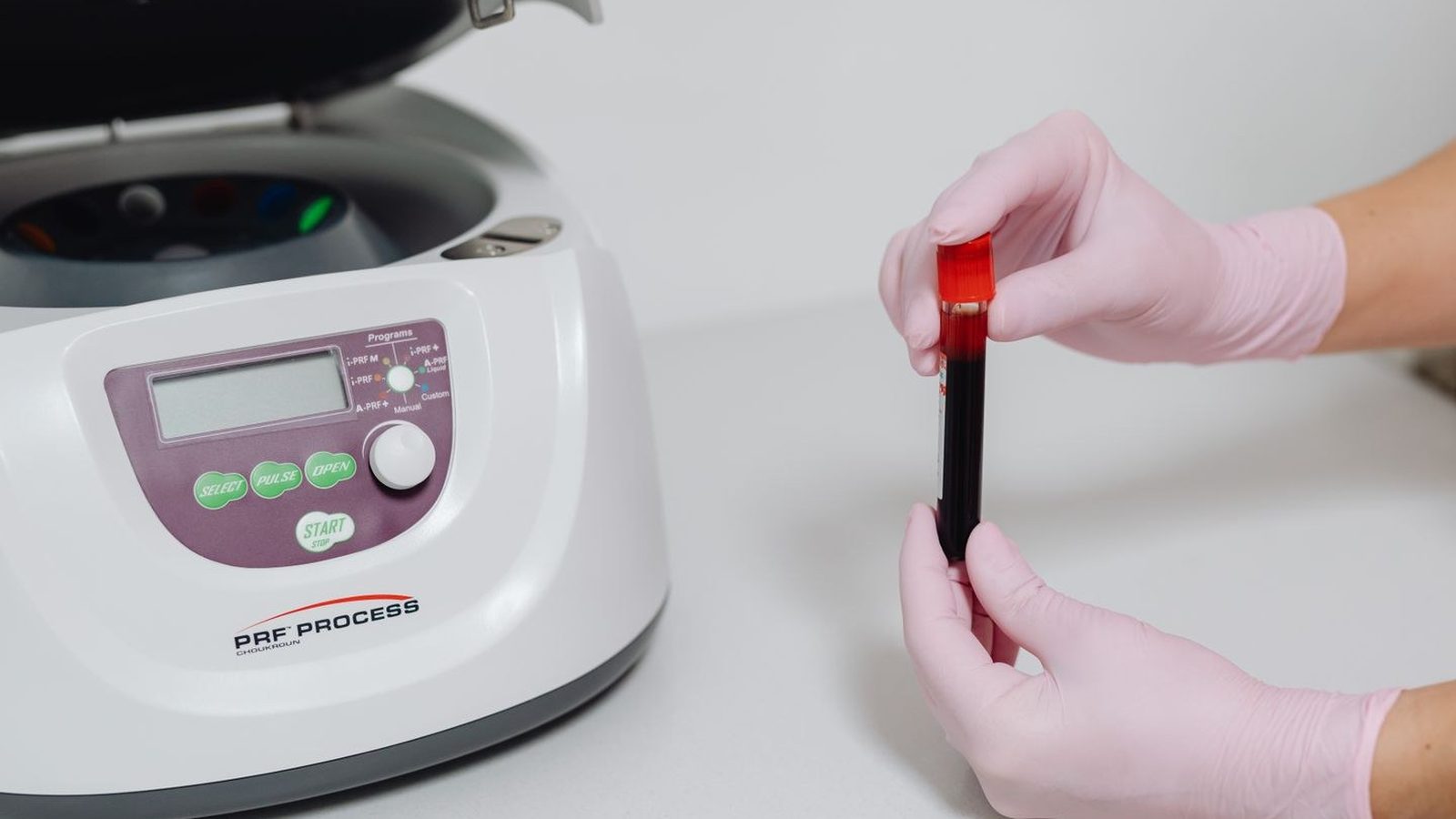
Start with a standard blood draw. Spun one way, the tube separates into layers, and the upper plasma layer is relatively poor in platelets. That layer is warmed to around 75 degrees Celsius for roughly ten minutes, which denatures the albumin in it and causes it to set into a gel. The gel is cooled, then recombined with liquid platelet-rich fibrin from a second tube.
The result is a soft, injectable material made entirely from your own blood, used to add volume. EZ Gel is a trade name for one commercial version of it. In the literature it is usually called albumin gel PRF, or Alb-PRF.
Where it gets used
Under-eye hollows and the tear trough are the dominant use, and the reason most people go looking for it. It is also used in nasolabial folds, temples, the backs of the hands, and sometimes alongside filler dissolution when a patient is moving away from synthetic products.
The appeal is straightforward. Patients who want volume without a synthetic filler, or who are not candidates for one, or who have decided they are done with fillers, have not had many options.
What the evidence shows, and where it stops
The founding characterisation study, published in Platelets in 2021, documented gradual growth factor release over ten days and improved fibroblast activity in laboratory conditions. Its authors stated plainly that the literature still lacked adequate reports on clinical advantages and that animal studies and clinical testing were needed.
Since then the human evidence remains thin. A randomised trial in ten volunteers compared albumin gel PRF against hyaluronic acid gel for a dental application and found no statistically significant difference between them. A prospective study of fifteen patients treating nasolabial folds reported most patients much or very much improved at twenty weeks. There are small retrospective series.
That is the whole picture. Small studies, short follow-up, and mostly outside aesthetic facial use.
The durability claim we will not repeat
You will read that bio-filler lasts twelve to eighteen months. Some pages say up to two years. Those figures are asserted without citation on essentially every page that carries them.
The number appears to descend from preclinical work on how long denatured albumin persists after implantation, which is roughly four to six months in animal models, and it grew in transit. Meanwhile the strongest systematic review of platelet preparations for the area around the eyes, published in 2025 across fourteen studies, found that PRF improvements often diminished by six months.
We are not going to publish a duration figure. When you ask us at consultation how long it lasts, the answer will be that most published studies follow patients to about six months, that improvement often fades by then, and that we plan a series and reassess rather than promising a number.
What it is not
It is not a dermal filler in the regulatory sense. Dermal fillers are approved devices in a different class, and autologous bio-filler does not belong to that category or borrow its approval.
It is not stem cell therapy. Nothing in this preparation should be described that way.
It is not FDA-approved. There is no approved indication for it, its use is off-label under the practice of medicine, and that is lawful and standard.
Coming to the practice this fall
Bio-filler is joining our regenerative program later this year, alongside the PRP and PRF protocols already offered. It is not bookable yet, and we would rather say so than take deposits on a treatment we are still bringing in.
When it launches it will be handled the way everything else here is: designed and supervised by Dr. Anna Frisch, MD, PhD, a board-certified endocrinologist, with every PRP injection performed by Dr. Frisch, with candidacy assessed at a consultation before anything is planned.
If you would like to be told when it is available, mention it at your next visit or when you contact the office.
Individual results vary.
Frequently Asked Questions
- What is PRF bio-filler?
- It is a soft, injectable material made entirely from your own blood. The platelet-poor plasma layer is warmed to around 75 degrees Celsius, which denatures the albumin so it sets into a gel, and that gel is cooled and recombined with liquid platelet-rich fibrin. EZ Gel is a trade name for one commercial version; in the literature it is usually called albumin gel PRF.
- How long does bio-filler last?
- We do not publish a duration figure. Most published studies follow patients to about six months, and a 2025 systematic review of platelet preparations around the eyes found improvements often diminished by then.
- Is bio-filler the same as a dermal filler?
- No. Dermal fillers are approved devices in a different regulatory class. Autologous bio-filler does not belong to that category or borrow its approval, and it is not stem cell therapy.
- Is bio-filler available at Palm Beach Cosmetic Medicine?
- Not yet. It is joining our regenerative program later this year and is not bookable today. If you would like to be told when it is available, mention it at your next visit or when you contact the office.
Dr. Anna Frisch, MD, PhD
Board-Certified Endocrinologist | Emory University School of Medicine-trained physician-scientist | Medical Director, Palm Beach Cosmetic Medicine | Founder, VitellaMD, Palm Beach Thyroid & Endocrinology Wellness, and Frisch Integrative Medicine
Dr. Anna Frisch, MD, PhD, is a board-certified endocrinologist, Emory University School of Medicine-trained physician-scientist, Medical Director of Palm Beach Cosmetic Medicine, and founder of VitellaMD, Palm Beach Thyroid & Endocrinology Wellness, and Frisch Integrative Medicine. She is one of the few board-certified endocrinologists in the US leading a cosmetic medicine practice. Her research is cited internationally, and she brings decades of experience in endocrinology, thyroid disorders, hormones, metabolic health, and patient-centered care. At Palm Beach Cosmetic Medicine, Dr. Frisch applies her medical background to aesthetic wellness by looking beyond the surface, connecting skin health, hair health, hormone balance, metabolic wellness, nutrition, collagen support, and advanced cosmetic treatments to help patients look refreshed, confident, and natural.
Not sure where to start?
Get your complimentary Skin IQ: a physician-led AI skin analysis with personalized recommendations in minutes.


Refined, physician-led cosmetic care in Wellington.
Schedule a private consultation to design a treatment plan around your skin, your goals, and the way you want to look and feel.