Laser Hair Removal for Dark Skin Tones: A Fitzpatrick IV to VI Guide to Nd:YAG 1064nm
Dark skin tones (Fitzpatrick IV to VI) need a specific wavelength, pulse duration, and cooling strategy. Here is how the Nd:YAG 1064nm on the Candela GentleMax Pro Plus is selected, set, and delivered safely at PBCM.

Laser hair removal on Fitzpatrick IV to VI skin is not the same procedure as on lighter skin. The wavelength, pulse duration, fluence, spot size, and cooling all have to shift, and the device has to be capable of those shifts in the first place. At PBCM in Wellington, FL, dark skin tones are treated with the 1064 nm Nd:YAG arm of the Candela GentleMax Pro Plus, paired with Dynamic Cooling Device (DCD) cryogen and physician-set parameters. This guide explains what that means and why it matters.
Fitzpatrick IV to VI: what the skin type actually means for laser
The Fitzpatrick scale describes how skin responds to ultraviolet light. Types IV, V, and VI cover olive, brown, and deeply pigmented skin: skin that tans easily and rarely burns. The clinically important point for laser hair removal is that this skin contains significantly more epidermal melanin than Fitzpatrick I to III skin.
Laser hair removal works by targeting melanin inside the hair follicle. The challenge with dark skin is that melanin in the epidermis competes with melanin in the follicle for the same light energy. The wrong wavelength, the wrong pulse duration, or inadequate cooling can deposit too much energy in the surface of the skin, leading to burns, blistering, post-inflammatory hyperpigmentation (PIH), or hypopigmentation. The right combination bypasses the epidermis and delivers energy where it belongs.
Why the 1064 nm Nd:YAG wavelength is the safest choice for dark skin
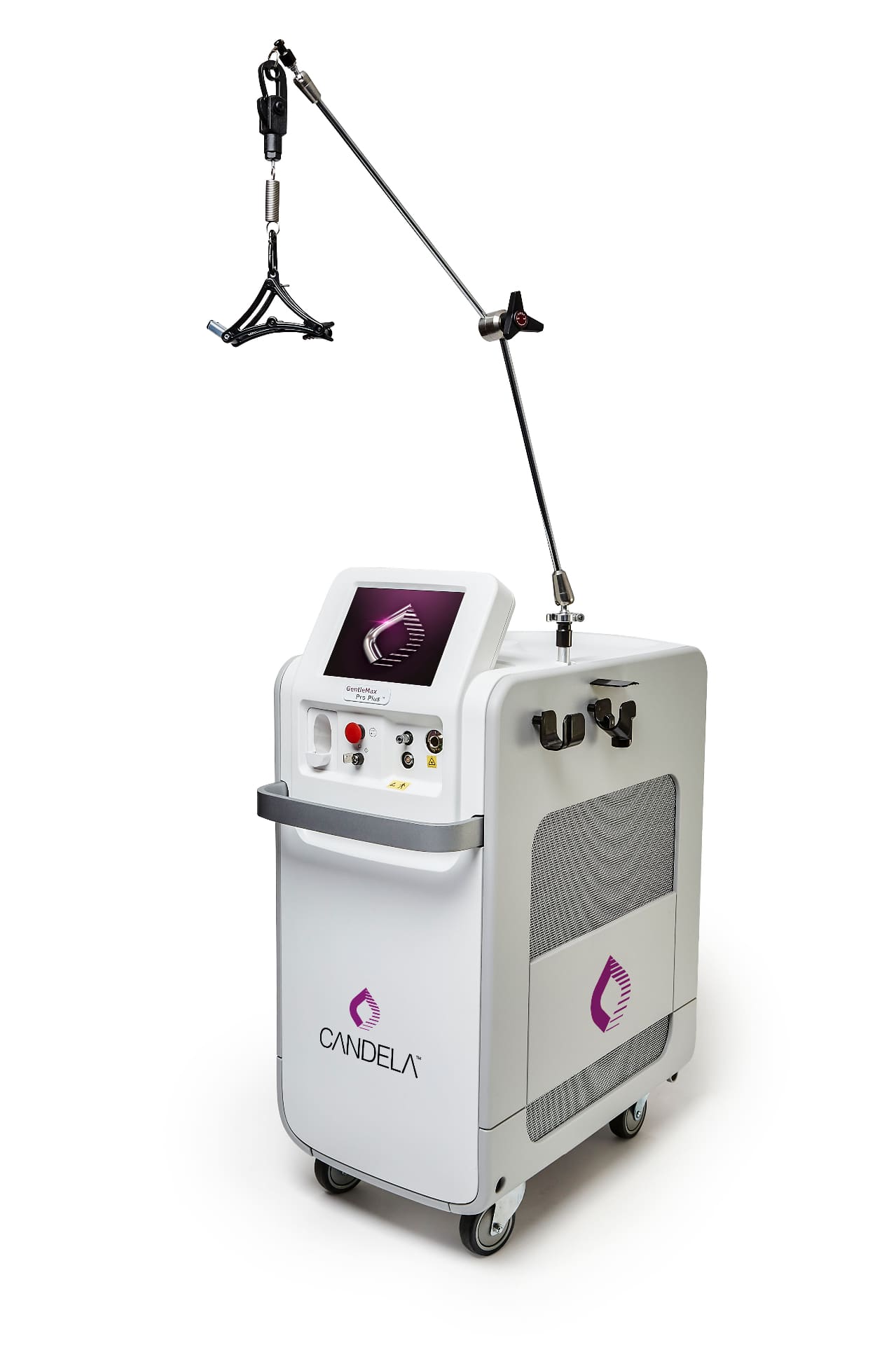
The Candela GentleMax Pro Plus is a dual-wavelength platform: a 755 nm Alexandrite laser and a 1064 nm Nd:YAG laser on one device. For Fitzpatrick IV to VI skin, the Nd:YAG is the appropriate wavelength.
The 1064 nm wavelength is poorly absorbed by epidermal melanin and penetrates more deeply into the dermis, where coarse terminal hair follicles actually live. That deeper, more selective absorption is the entire point: the laser targets the follicle without significantly heating the pigmented surface. Decades of peer-reviewed literature on Nd:YAG for skin of color support this; it remains the gold-standard wavelength for safe, effective hair reduction on darker tones.
Single-wavelength devices that rely on diode (typically 810 nm) or Alexandrite (755 nm) sit higher on the melanin-absorption curve. They can be made to work on darker skin only by lowering energy, which usually means more sessions and weaker results, or risk pigmentary side effects. Intense pulsed light (IPL) is not a true laser and is generally contraindicated for Fitzpatrick V to VI.
Pulse duration, spot size, and Dynamic Cooling: the settings that matter
Wavelength is the headline, but it is not the whole story. On Nd:YAG for dark skin, longer pulse durations spread the energy delivery over more time, which is gentler on the epidermis. Larger spot sizes drive light deeper into the dermis with less scatter. Both choices favor follicular heating over surface heating.
The Candela platform pairs every pulse with Dynamic Cooling Device (DCD): a precisely timed burst of cryogen that cools the epidermis immediately before the laser fires. Contact cooling alone (used by many diode devices) does not protect dark skin as reliably. Pre-pulse cryogen does, and it is one of the reasons the Candela line is widely cited in dermatologic literature for skin of color.
How a Fitzpatrick IV to VI treatment plan is built at PBCM
At consultation, Dr. Frisch confirms Fitzpatrick type by examination, not by self-report alone, since lighting and recent sun exposure can be misleading. The hair color, density, depth, and treatment area are evaluated, along with medications, hormonal context (PCOS, perimenopause, gender-affirming care), recent sun exposure, and any prior laser, IPL, waxing, or electrolysis.
If the skin has been recently tanned, sessions are delayed. If the patient is on photosensitizing medications or recent isotretinoin, the plan is adjusted. Once the skin is ready, the Nd:YAG is selected and pulse duration, fluence, and spot size are set for that visit, not preset from a generic menu.
Most patients need a series of 6 to 8 sessions spaced 6 to 10 weeks apart, with the exact cadence depending on body region and hair cycle. Maintenance visits are common for hormonally driven hair patterns.
Side effects to know about, and how they are prevented
The risks specific to dark skin are post-inflammatory hyperpigmentation (PIH), hypopigmentation, blistering, and crusting. These are almost always the result of the wrong wavelength, excessive energy, inadequate cooling, or treating recently tanned skin.
Expected, normal responses to a well-set Nd:YAG treatment include mild redness around follicles (perifollicular edema) for a few hours, slight warmth, and occasional shedding of treated hairs over 1 to 2 weeks. Anything more than that should be reported.
Pre- and post-care matters: strict sun protection (SPF 50+) in the treatment area, no self-tanners, no waxing or threading between sessions, and gentle skincare for 48 to 72 hours after treatment. Bleaching agents are not used prophylactically at PBCM unless specifically indicated.
Why physician-led care matters more on dark skin
On Fitzpatrick I to III skin, a wide range of devices and operators can produce acceptable results. On Fitzpatrick IV to VI skin, the margin for error is narrower and the consequences of a poor decision (wrong wavelength, too much energy, missed contraindication) are more visible and longer-lasting.
PBCM is physician-led for this reason. Dr. Frisch, MD, PhD, sets the plan, selects the wavelength, and supervises every laser hair removal visit. The Candela GentleMax Pro Plus gives her the technical range; the consultation gives the plan its judgment.
Frequently Asked Questions
- Is laser hair removal safe for dark skin (Fitzpatrick IV, V, and VI)?
- Yes, when the 1064 nm Nd:YAG wavelength is used with appropriate pulse duration and pre-pulse cryogen cooling. The Candela GentleMax Pro Plus at PBCM is specifically equipped for Fitzpatrick IV to VI skin, and the plan is set by a physician at consultation.
- What wavelength is used for laser hair removal on dark skin?
- The 1064 nm Nd:YAG wavelength. It is poorly absorbed by epidermal melanin and penetrates deeply enough to target the follicle without overheating pigmented skin at the surface. It is the gold-standard wavelength for Fitzpatrick IV to VI in the dermatologic literature.
- Can IPL or diode lasers be used on Fitzpatrick V to VI skin?
- Generally no for IPL, which is not a true laser and is typically contraindicated on the deepest skin tones. Single-wavelength diode devices (810 nm) sit higher on the melanin-absorption curve than Nd:YAG and carry more risk of burns and pigmentary change on dark skin. Nd:YAG 1064 nm is the preferred choice.
- What are the risks of laser hair removal on dark skin?
- Post-inflammatory hyperpigmentation, hypopigmentation, blistering, and crusting are the main risks, and they are almost always linked to wrong wavelength selection, excessive energy, inadequate cooling, or treating recently tanned skin. Strict sun avoidance before sessions and physician-set parameters significantly reduce these risks.
- How many sessions does laser hair removal take on dark skin?
- Most patients complete a series of 6 to 8 sessions spaced 6 to 10 weeks apart, with maintenance visits as needed, particularly for hormonally driven hair growth. Cadence and total number depend on body area, hair cycle, and individual response.
- Why does PBCM use the Candela GentleMax Pro Plus for dark skin?
- It is a dual-wavelength platform with a true 1064 nm Nd:YAG laser and Dynamic Cooling Device (DCD) cryogen that fires immediately before each pulse. That combination, proper wavelength plus pre-pulse cryogen cooling, is what makes Fitzpatrick IV to VI treatment safe and effective.
Dr. Anna Frisch, MD, PhD
Board-Certified Endocrinologist | Emory University School of Medicine-trained physician-scientist | Medical Director, Palm Beach Cosmetic Medicine | Founder, VitellaMD, Palm Beach Thyroid & Endocrinology Wellness, and Frisch Integrative Medicine
Dr. Anna Frisch, MD, PhD, is a board-certified endocrinologist, Emory University School of Medicine-trained physician-scientist, Medical Director of Palm Beach Cosmetic Medicine, and founder of VitellaMD, Palm Beach Thyroid & Endocrinology Wellness, and Frisch Integrative Medicine. She is one of the few board-certified endocrinologists in the US leading a cosmetic medicine practice. Her research is cited internationally, and she brings decades of experience in endocrinology, thyroid disorders, hormones, metabolic health, and patient-centered care. At Palm Beach Cosmetic Medicine, Dr. Frisch applies her medical background to aesthetic wellness by looking beyond the surface, connecting skin health, hair health, hormone balance, metabolic wellness, nutrition, collagen support, and advanced cosmetic treatments to help patients look refreshed, confident, and natural.
Not sure where to start?
Get your complimentary Skin IQ: a physician-led AI skin analysis with personalized recommendations in minutes.


Refined, physician-led cosmetic care in Wellington.
Schedule a private consultation to design a treatment plan around your skin, your goals, and the way you want to look and feel.