Candela vs. Láser de Diodo para Depilación: Comparación de un Médico en Wellington
Muchas clínicas de Wellington y Palm Beach County usan láseres de diodo. PBCM usa el Candela GentleMax Pro Plus. Esta es la comparación a nivel médico: longitudes de onda, tipos de piel, enfriamiento y control clínico.
Si está comparando proveedores de depilación láser en Wellington, casi con seguridad está comparando dos familias de equipos: los láseres de diodo y el Candela GentleMax Pro Plus. La mayoría de los med spas de la zona, incluidos centros como PB Anti-Aging, trabajan con una plataforma de diodo de una sola longitud de onda. En Palm Beach Cosmetic Medicine elegí el Candela GentleMax Pro Plus porque ofrece dos longitudes de onda clínicamente distintas en un solo equipo y un sistema integrado de enfriamiento criogénico. La diferencia no es de marketing. Determina qué pacientes pueden tratarse de forma segura, con qué rapidez aparecen los resultados y qué ocurre cuando la piel es más oscura, está expuesta al sol o reacciona a los cambios hormonales.
La depilación láser funciona por fototermólisis selectiva
La depilación láser se basa en la fototermólisis selectiva. La melanina del tallo y del folículo piloso absorbe una longitud de onda específica de luz. El folículo se calienta, la región de células madre se daña y el vello entra en una fase de reposo prolongada. El reto es que la melanina también está presente en la propia piel, por lo que la longitud de onda, la duración del pulso, la energía y el enfriamiento deben favorecer al folículo por encima de la epidermis.
Cada longitud de onda penetra a una profundidad diferente y se absorbe de manera distinta en la piel y en el vello. Por eso la plataforma del equipo es la primera pregunta médica, no la última. Una clínica que solo dispone de una longitud de onda solo puede tratar bien a una parte de la población de pacientes.
El láser de diodo es un láser real con una longitud de onda intermedia
Los láseres de diodo que se usan para depilación suelen operar entre 800 y 810 nm. Entre las plataformas habituales en Wellington y Palm Beach County están LightSheer, Soprano (y Soprano ICE), Vectus, Primelase y Motus AY en modo diodo. Son láseres reales, no IPL, y en el caso adecuado funcionan.
La longitud de onda de 810 nm del diodo se sitúa entre la de la alejandrita (755 nm) y la del Nd:YAG (1064 nm). Es una longitud de onda de compromiso: penetra más que la alejandrita y menos que el Nd:YAG, con una absorción intermedia por la melanina. En tonos de piel intermedios (fototipos de Fitzpatrick III a IV) y vello de grosor promedio, el diodo puede dar buenos resultados.
Muchas plataformas de diodo se promocionan con una técnica de barrido "en movimiento" (in-motion) que aplica poca energía durante un tiempo de contacto prolongado. Es cómoda y rápida, pero la energía por pulso es menor que con la técnica tradicional de disparo por disparo (stamping). A veces se necesitan sesiones adicionales para alcanzar la misma reducción folicular que una pasada de alejandrita o Nd:YAG de mayor fluencia lograría en menos visitas.
El Candela GentleMax Pro Plus combina dos láseres verdaderos en una sola plataforma
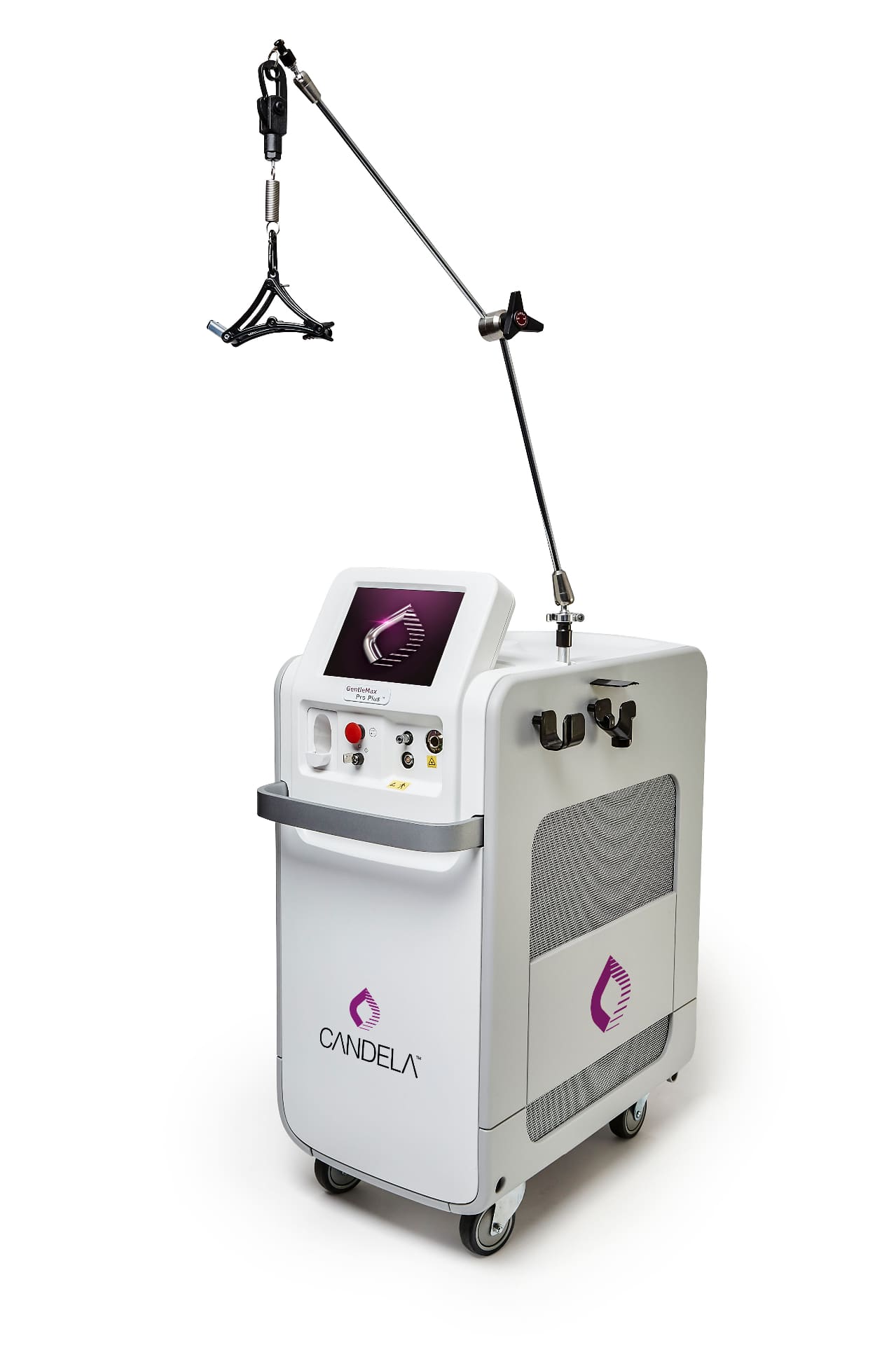
El Candela GentleMax Pro Plus no es un diodo. Es un sistema de doble longitud de onda que combina un láser de alejandrita de 755 nm y un láser Nd:YAG de 1064 nm en una sola plataforma, con un sistema integrado de pulverización criogénica llamado Dynamic Cooling Device (DCD).
La longitud de onda de 755 nm de la alejandrita es, entre las longitudes de onda clínicas para depilación, la que más absorbe la melanina. En fototipos de Fitzpatrick I a III con vello oscuro de fino a medio, la alejandrita suele eliminar más vello por sesión que el diodo con una comodidad comparable, porque llega más energía al folículo por cada fotón aplicado.
La longitud de onda de 1064 nm del Nd:YAG penetra más profundamente y la melanina de la epidermis la absorbe menos. En fototipos IV a VI, en piel recién bronceada o en vello grueso de raíz profunda (barba, espalda, zona del bikini), el Nd:YAG es la longitud de onda más segura y eficaz. El diodo de 810 nm queda en un punto intermedio: puede usarse en piel más oscura, pero con un margen de seguridad más estrecho que el Nd:YAG a las energías necesarias para una verdadera destrucción folicular.
Contar con ambas longitudes de onda en un solo equipo significa que no es la piel de cada paciente la que debe adaptarse al equipo. La longitud de onda se adapta a la persona que tengo delante.
La cobertura segura de los fototipos de Fitzpatrick I a VI depende de la longitud de onda
La población de pacientes de Wellington abarca toda la escala de Fitzpatrick, desde la piel muy clara hasta la piel intensamente pigmentada, a menudo con una exposición solar importante durante todo el año. Un centro que trata solo con diodo tiene que aplicar la misma longitud de onda en todos esos escenarios.
En los fototipos I a III, la alejandrita generalmente supera al diodo en rapidez de eliminación y en reducción total. En los fototipos V a VI, el Nd:YAG se considera ampliamente la longitud de onda más segura, porque su mayor penetración y su menor absorción por la melanina epidérmica reducen el riesgo de quemaduras y de hiperpigmentación postinflamatoria. En el fototipo IV y en piel bronceada, el Nd:YAG con el enfriamiento adecuado suele ser una opción más conservadora y predecible que el diodo de 810 nm a las energías necesarias para destruir realmente el folículo.
Para el vello facial asociado al síndrome de ovario poliquístico (SOP), el vello del mentón y la mandíbula en la perimenopausia, el perfilado de la barba y la pseudofoliculitis de la barba, el brazo Nd:YAG del Candela es la longitud de onda que indico con más frecuencia. Las plataformas de diodo de una sola longitud de onda simplemente no ofrecen esa misma opción a quien realiza el tratamiento.
Enfriamiento: Dynamic Cooling Device frente a enfriamiento por contacto
La mayoría de las plataformas de diodo enfrían la piel con una punta de zafiro refrigerada apoyada sobre la zona de tratamiento o con aire frío. Son protecciones reales y, con fluencias bajas, funcionan. Pero el enfriamiento por contacto mantiene una temperatura estable; no responde al momento exacto del pulso láser.
El Dynamic Cooling Device (DCD) de Candela pulveriza sobre la piel una ráfaga de criógeno sincronizada con precisión en los milisegundos inmediatamente anteriores a cada pulso láser. Ese enfriamiento breve e intenso permite administrar con seguridad fluencias por pulso más altas, que es exactamente lo que se necesita para una reducción folicular permanente, sobre todo en vello grueso o piel más oscura.
El enfriamiento no es un argumento de comodidad. Es el mecanismo que permite aplicar energía de forma intensa y a la vez segura. En un diodo que solo tiene enfriamiento por contacto, a menudo hay que reducir la energía para proteger la epidermis, lo que puede significar más sesiones para el mismo resultado.
Control clínico y selección de parámetros dirigida por médicos
Un equipo es tan bueno como el profesional clínico que lo ajusta. En PBCM, cada plan láser se diseña durante una consulta médica. Antes de aplicar cualquier pulso, evalúo el fototipo de Fitzpatrick, el color y la densidad del vello, la zona de tratamiento, los antecedentes hormonales, los medicamentos, la exposición solar reciente y la experiencia previa con láser.
A partir de esa evaluación defino la longitud de onda (755 nm o 1064 nm), el tamaño del punto (spot), la duración del pulso, la fluencia y la sincronización del criógeno del DCD. La plataforma Candela da acceso a todos esos parámetros y permite ajustarlos por zona corporal dentro de una misma visita. Muchas plataformas de diodo, en particular las variantes en movimiento, están diseñadas para operarse con rapidez y con pocos cambios de parámetros, lo que en parte explica su popularidad en los med spas de alto volumen.
Otro modelo de negocio, otro equipo, otro resultado. PBCM está organizado como un consultorio de medicina estética dirigido por médicos, y el Candela GentleMax Pro Plus es la herramienta que corresponde a ese estándar.
Cuándo los láseres de diodo siguen teniendo un papel
Quiero ser clara: los láseres de diodo no son malos láseres. Para una persona con fototipo II a IV, vello oscuro de grosor medio a grueso, sin exposición solar reciente y sin complejidad hormonal, un plan de tratamiento con diodo bien llevado puede dar buenos resultados. El Soprano ICE, en particular, se ha ganado su reputación de comodidad.
El argumento a favor del Candela GentleMax Pro Plus no es que el diodo nunca funcione. Es que una plataforma de doble longitud de onda alejandrita/Nd:YAG con enfriamiento criogénico cubre a más pacientes de forma segura y más eficiente, con menos sesiones para muchas personas y con un margen de seguridad más amplio en piel más oscura. Cuando se puede elegir entre ambos equipos, la plataforma de doble longitud de onda es la opción médica más sólida.
Preguntas para cualquier proveedor de láser en Wellington
Antes de reservar depilación láser en cualquier clínica, incluida la nuestra, pregunte: ¿Qué equipo láser utilizan y es un láser verdadero (no IPL)? ¿Es un diodo de una sola longitud de onda o dispone de alejandrita y Nd:YAG? ¿Cómo se enfría la piel: por contacto, con aire o con criógeno DCD? ¿Un médico evaluará mi fototipo de Fitzpatrick, las características de mi vello y mis antecedentes médicos antes de elegir los parámetros? ¿Quién elige los parámetros en cada sesión: un médico, personal de enfermería o un técnico?
Las respuestas indican si está comprando un paquete de sesiones o recibiendo un plan médico. En PBCM la respuesta es siempre la misma: Candela GentleMax Pro Plus de doble longitud de onda, Dynamic Cooling Device integrado y selección de parámetros dirigida por médicos, bajo la dirección clínica de la Dra. Anna Frisch, MD, PhD, endocrinóloga certificada.
Preguntas Frecuentes
- ¿Es el Candela GentleMax Pro Plus mejor que un láser de diodo para la depilación?
- Para la mayoría de los pacientes, sí. El Candela GentleMax Pro Plus ofrece dos longitudes de onda clínicas verdaderas (alejandrita de 755 nm y Nd:YAG de 1064 nm) más enfriamiento criogénico integrado. Los láseres de diodo operan con una única longitud de onda de aproximadamente 810 nm, que es un punto intermedio entre la alejandrita y el Nd:YAG. El Candela de doble longitud de onda cubre una gama más amplia de fototipos de Fitzpatrick, permite fluencias seguras más altas en piel más oscura gracias al Nd:YAG y, en muchos pacientes, suele lograr la misma reducción folicular en menos sesiones.
- ¿Qué es más seguro para la piel más oscura: el diodo o el Candela?
- En los fototipos de Fitzpatrick IV a VI, la longitud de onda Nd:YAG de 1064 nm del Candela GentleMax Pro Plus se considera ampliamente la opción más segura, porque penetra más profundamente y la melanina epidérmica la absorbe menos, lo que reduce el riesgo de quemaduras e hiperpigmentación postinflamatoria. El diodo de 810 nm puede usarse en piel más oscura, pero con un margen de seguridad más estrecho que el Nd:YAG.
- ¿Necesitaré más sesiones con un láser de diodo que con el Candela?
- Con frecuencia, sí. Muchas plataformas de diodo, sobre todo los equipos en movimiento, aplican menos energía por pulso repartida en un tiempo de contacto más largo. Es cómodo, pero puede requerir sesiones adicionales para lograr la misma destrucción folicular que consiguen las pasadas de alejandrita o Nd:YAG de mayor fluencia con el Candela. Los resultados individuales varían según el fototipo, las características del vello y el contexto hormonal.
- ¿Cuál es la diferencia entre el Dynamic Cooling Device (DCD) y el enfriamiento por contacto?
- El DCD pulveriza sobre la piel una ráfaga de criógeno sincronizada con precisión en los milisegundos previos a cada pulso láser, lo que permite fluencias seguras más altas. El enfriamiento por contacto (puntas de zafiro refrigeradas o aire frío, como en la mayoría de las plataformas de diodo) mantiene una temperatura estable de la piel, pero no ofrece el mismo enfriamiento justo en el momento preciso. El DCD es una razón clave por la que los tratamientos con Candela pueden usar parámetros intensos y eficaces de forma segura.
- ¿Qué clínicas de depilación láser en Wellington usan diodo y cuáles usan Candela?
- La mayoría de los med spas de Wellington y Palm Beach County, incluidos centros como PB Anti-Aging, tratan con plataformas de diodo de una sola longitud de onda. Palm Beach Cosmetic Medicine trata exclusivamente con el Candela GentleMax Pro Plus de doble longitud de onda. Antes de reservar su primera sesión, pregunte en cualquier clínica qué equipo específico utilizan: diodo, alejandrita, Nd:YAG o IPL.
- ¿Puede el Candela GentleMax Pro Plus tratar el vello facial hormonal o por síndrome de ovario poliquístico (SOP)?
- Sí. El vello facial asociado al SOP y a la perimenopausia suele ser grueso y estar reforzado por las hormonas, que es exactamente donde el brazo Nd:YAG de 1064 nm de la plataforma Candela resulta más útil. En PBCM, la Dra. Anna Frisch, endocrinóloga certificada, planifica estos tratamientos junto con la evaluación hormonal de fondo cuando corresponde.
Dr. Anna Frisch, MD, PhD
Board Certified in Endocrinology | Médica e investigadora formada en Emory University School of Medicine | Directora médica de Palm Beach Cosmetic Medicine | Fundadora de VitellaMD, Palm Beach Thyroid & Endocrinology Wellness y Frisch Integrative Medicine
La Dra. Anna Frisch, MD, PhD, cuenta con la certificación Board Certified in Endocrinology, es médica e investigadora formada en Emory University School of Medicine, directora médica de Palm Beach Cosmetic Medicine y fundadora de VitellaMD, Palm Beach Thyroid & Endocrinology Wellness y Frisch Integrative Medicine. Es una de las pocas endocrinólogas con certificación de especialidad en Estados Unidos que dirigen un consultorio de medicina estética. Su investigación se cita internacionalmente y aporta décadas de experiencia en endocrinología, trastornos tiroideos, hormonas, salud metabólica y atención centrada en el paciente. En Palm Beach Cosmetic Medicine aplica su formación médica al bienestar estético, considerando la salud de la piel y el cabello, el equilibrio hormonal, la salud metabólica, la nutrición, el apoyo al colágeno y los tratamientos estéticos avanzados para ayudar a los pacientes a verse renovados, seguros y naturales.
¿No sabe por dónde empezar?
Obtenga su Skin IQ de cortesía: un análisis de piel con IA dirigido por un médico, con recomendaciones personalizadas en minutos.
Artículos relacionados


Atención estética refinada, dirigida por médicos en Wellington.
Programe una consulta privada para diseñar un plan de tratamiento adaptado a su piel, sus objetivos y a cómo desea verse y sentirse.